
Five Words About Touch
In 1911 a copywriter from Covington, Kentucky, sold a cake of soap by taking the soap out of the picture. The century of beauty advertising begins on that page.
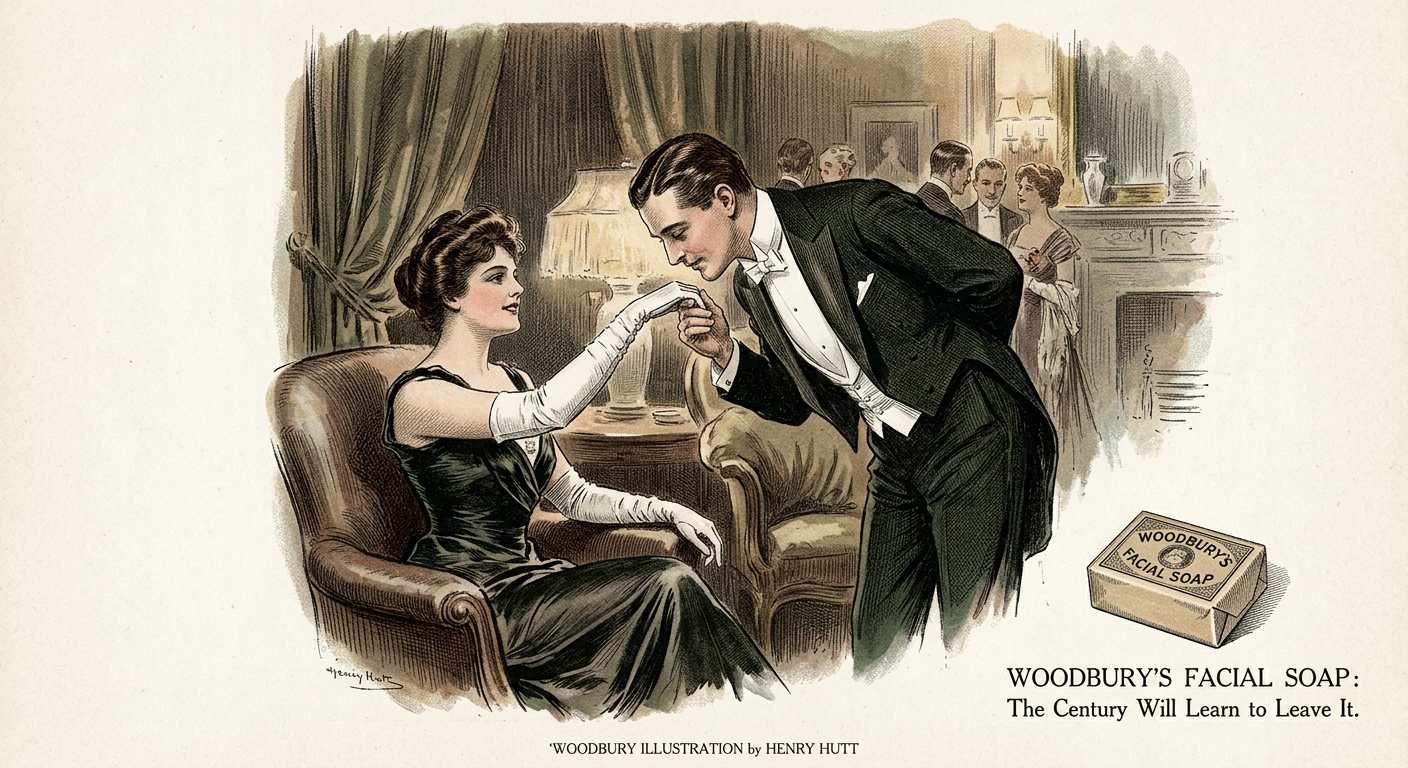
Look at the hand first. It belongs to a young woman in evening dress, and it is being lifted, not shaken. The man leaning toward it is in white tie, and he has not yet reached her fingers, which is the whole of the picture's technique. Above them runs a line of five words that says nothing at all about soap.
The illustration was commissioned from the American artist Henry Hutt. It appeared first, in 1911, on the cover of a fifty-cent volume called The Woodbury Book, whose first edition of ten thousand copies sold out. Later that same year the image and the line were put together in a magazine advertisement, and the phrase entered the language, where it stayed for thirty years.
“A skin you love to touch.”
Woodbury's Facial Soap, 1911
The cake of Woodbury's Facial Soap appears in the corner of the page, reduced to a reminder. Everything above it is a promise about being touched.
Covington
Helen Bayless Lansdowne was born on February 20, 1886, one of several children raised by a mother who worked as a librarian and as a real estate agent, in a household where a woman earning was not a scandal but the arrangement. She left high school in 1903 and went straight into work.
The resume that follows is short and it is all commerce. A local manufacturer in Covington. Then Cincinnati, across the river, where she took a job as a bill auditor at Procter and Collier, an advertising agency, which is to say she entered the business through its ledgers rather than its ideas. Then retail copy for the Commercial Tribune, a Cincinnati newspaper. In 1906, a copywriter's post at the Street Railways Advertising Company, writing for the eye of a passenger with nothing else to read.
In 1907 a young Yale graduate named Stanley Resor, then at Procter and Collier, asked her to come back to the agency as a copywriter. She worked on Red Cross shoes. In 1908, when the J. Walter Thompson Company opened a Cincinnati branch and put Resor in charge of it, she went with him as the agency's first woman copywriter. In early 1911 she was promoted to the New York office.
She was twenty-five years old, and the account waiting for her was a soap nobody much wanted.
A neckless head on a wrapper
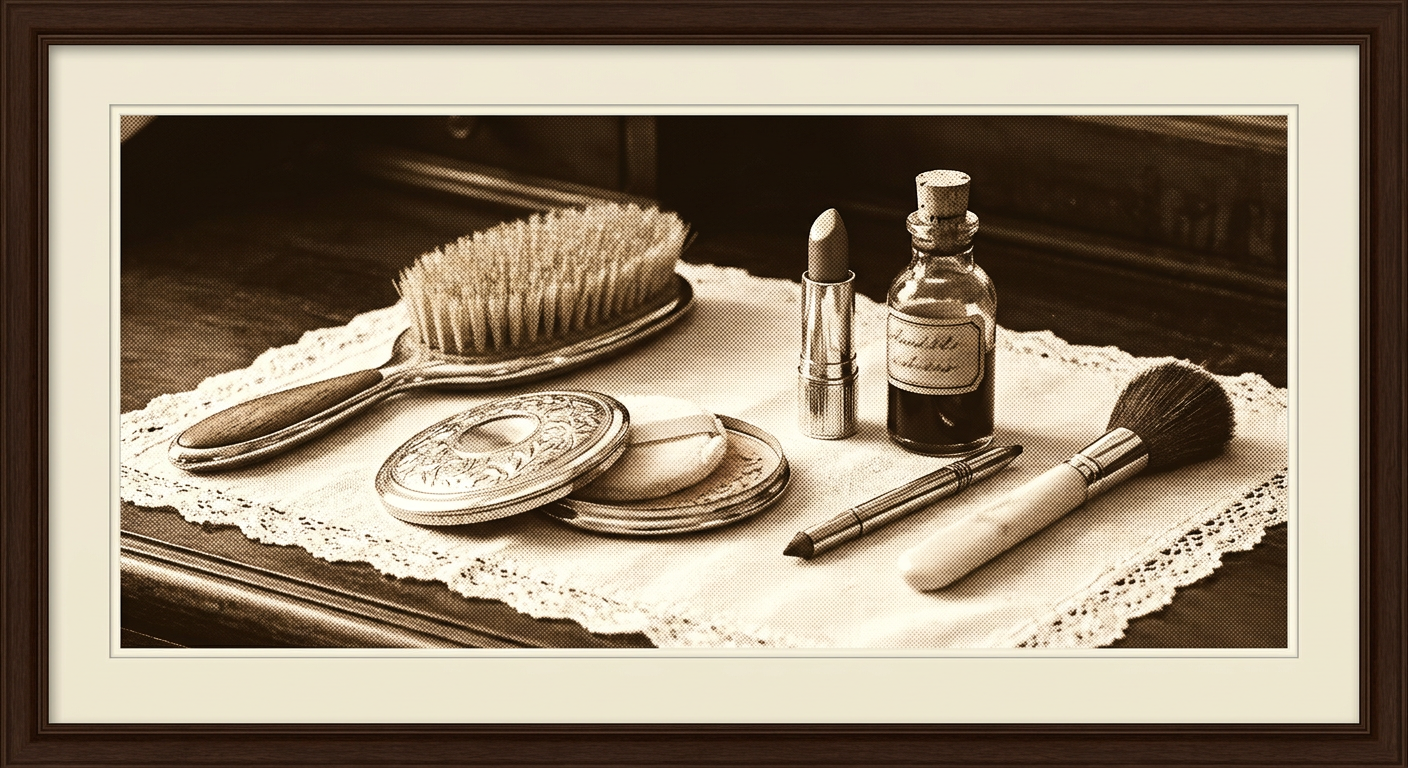
Woodbury's Facial Soap was invented in the 1870s by a dermatologist, John H. Woodbury, and it carried his portrait on the wrapper, cropped severely above the neck. The Andrew Jergens Company of Cincinnati bought eight Woodbury products from him in 1901, and kept the face on the paper. Woodbury himself died in 1909.
The soap sold, but it did not lead. Jergens turned the account over to J. Walter Thompson in 1910, and Helen Lansdowne studied the problem for six months before writing a line of copy. What she produced first was not romance at all. It was a series of advertisements on the subject of nose pores, and how to reduce them.
That sounds like a joke now and it was not one. The nose-pore advertisements did the thing the industry had not been doing. They discussed the reader's difficulty rather than the manufacturer's virtue. The face came off the wrapper and the customer's face went onto the page.
Stanley Resor, addressing a J. Walter Thompson class in 1920, said of the account that it touches almost every problem of an advertiser. He was speaking as a man who had watched it happen.

The country the page landed in
Consider what an American magazine reader in 1911 had lately been through.
For most of the nineteenth century the back pages of her periodicals had belonged to the patent medicine trade, and the trade had been in open retreat for a decade. The Ladies' Home Journal had banned patent medicine advertising in 1892. Its editor, Edward Bok, ran an analysis in 1904 showing what was actually in the tonics, with alcohol contents that ran from twenty to forty-seven percent, and took the lawsuits that followed. The Pure Food and Drug Act arrived in 1906 and required the makers of medicines to say on the package what was in them.
By 1911 the advertising business was in the middle of cleaning its own house. That year the trade journal Printers' Ink commissioned the lawyer Harry D. Nims to draft what became the Printers' Ink Model Statute, a state law making untruthful, deceptive, or misleading advertising a misdemeanor, and placing the responsibility on the advertiser. It was adopted widely. A later edition of the Encyclopaedia Britannica would date the whole modern period of the business from that year on the strength of it.
So the page was being emptied of the claim just as it was being handed the picture. A house could no longer promise a cure. It could still promise a feeling, and no statute in America addressed itself to a feeling.
The audience had also arrived. The Ladies' Home Journal became the first American magazine to reach a million subscribers in 1903. A full page in it now put an illustration in front of a national readership in a single afternoon, which no shop window and no salon could do.
And the woman on the receiving end of it had changed address. As the historian who wrote the standard classroom reading on this campaign puts it, the notions of separate spheres for men and women were weaker than they had been, and young women living away from parental restraint, marrying later, had new occasions to meet and perhaps find romance. The advertisement is addressed to exactly that woman. Unmarried, urban, comfortable, and out in the evening.
“Popularizing a twenty-five cent soap in face of ten-cent products.”
The trade account of the campaign, Advertising and Selling, September 1915
What the page actually did
The commercial problem is worth stating plainly, because it is the reason the campaign is studied. Woodbury's Facial Soap cost twenty-five cents. Its competitors cost ten. The trade press of 1915 described the achievement in exactly those terms in its headline, and the achievement was not that Jergens undercut anybody. It was that a woman was persuaded to pay two and a half times the going rate for a bar of soap.
The most successful American soap advertising before this had been Procter and Gamble's for Ivory, which put the bar at the center of the illustration and told you it was Ninety-nine and 44 one-hundredths percent pure. The claim was about the object. Woodbury's claim was about what happened to the person holding it.
The body copy, meanwhile, did not float. It was practical to the point of severity, and it stayed that way for years. A Woodbury advertisement of 1919 instructed the reader to apply hot cloths until the skin reddened, work a heavy lather in with a rough washcloth, always upward and outward, rinse hot, then cold, the colder the better, and finish by rubbing the face for thirty seconds with a lump of ice.
That is the shape of the thing. A romantic promise at the top of the page, a regimen underneath it, and a coupon at the bottom offering a sample. The reader was flattered and then given homework.

The noise
The campaign caused an uproar, and the uproar is now the part everybody knows. Readers were scandalized. Subscriptions were canceled. It is repeated in every history of the business, and it should be repeated with one honest caveat: the specific numbers usually attached to it are difficult to trace to a contemporary source, and this page will not invent one. What can be said is that the reaction was substantial enough to be recorded in the trade at the time and remembered in it for half a century.
It is worth being precise about what the offense consisted of, because a modern eye looking at the Hutt illustration will not find it. Nobody is undressed. Nobody is even touching, quite. Two people in formal evening clothes are observing a courtesy that was, in 1911, entirely permissible in a drawing room and entirely permissible in a novel.
The trespass was in the caption. A picture of a courtship was ordinary; a picture of a courtship placed under a line that offered the reader the same courtship, for twenty-five cents, in the middle of a magazine she took for the household, was not. The page collapsed the distance between a story about a woman and an inventory of what a woman might buy. That is the thing the letters were about, and it is why the campaign is a landmark rather than merely a pretty piece of commercial art.
There was a professional objection running underneath the moral one. The advertising business had spent a decade making itself respectable, and the Printers' Ink statute of that very year was the proof of the effort. A trade insisting on its new sobriety could reasonably find it awkward that its most talked-about page of the season worked on precisely the register the trade had been trying to leave behind. The difference, and it is the whole difference, is that Woodbury's promise could not be tested in a laboratory and therefore could not be prosecuted. The nostrum had claimed to cure. The soap only implied.
Albert Lasker of Lord and Thomas, who was not a man given to admiring a rival's work, called the advertisement's use of sex appeal one of the three great landmarks in the history of advertising.
The claim that it was the first, though, deserves a straight look. Richard Ohmann has pointed out that themes of physical attractiveness already ranked high in magazine advertising of the 1890s, particularly in advertising addressed to women. Desire was not discovered in 1911. What was new was the frankness of the transaction on a mass-circulation page, and the fact that it survived the editors. By the 1920s, with the line slightly altered to The Skin You Love to Touch, the same advertisement read as routine rather than risque, which is the ordinary fate of a scandal that works.
Woodbury went on testing the boundary. In 1936 the soap's filtered sunshine campaign, built around the addition of vitamin D, ran photographs of nudes by Edward Steichen, and marked another American advertising first. The vitamin claim brought the company into conflict with the Federal Trade Commission in 1941, under the Wheeler-Lea Act. The picture kept getting bolder. The copy kept getting checked.
The register
Set against the noise, the numbers.
Woodbury's sales reached 2,147,000 dollars by 1919, most of the growth coming from Facial Soap, according to a figure published in The American Perfumer and Essential Oil Review in 1922. The quarter-dollar price held through the boom. It did not survive the slump: Jergens cut the soap to ten cents in 1934 and to as little as five cents by 1939, by which time Woodbury was a budget brand competing with Lux and Camay, and Jergens stopped advertising it in Vogue in 1940.
The line outlasted the price. Woodbury used it into the 1940s, which is to say the phrase written by a twenty-five-year-old in 1911 was still doing commercial work when the women who first read it were sending sons to a second war.
“A soap at two and a half times the going rate, sold on a promise no laboratory could test.”
Advertising Age would later rank the campaign thirty-first among the hundred best of the twentieth century.
You will also see it said that the campaign raised Woodbury's sales by a thousand percent over eight years. The figure is widely repeated and, so far as this page can establish, not attached to a primary document. The 1919 sales total is. Take the one and treat the other as folklore.
The counter follows the page
What happened next is the part that matters more than the scandal.
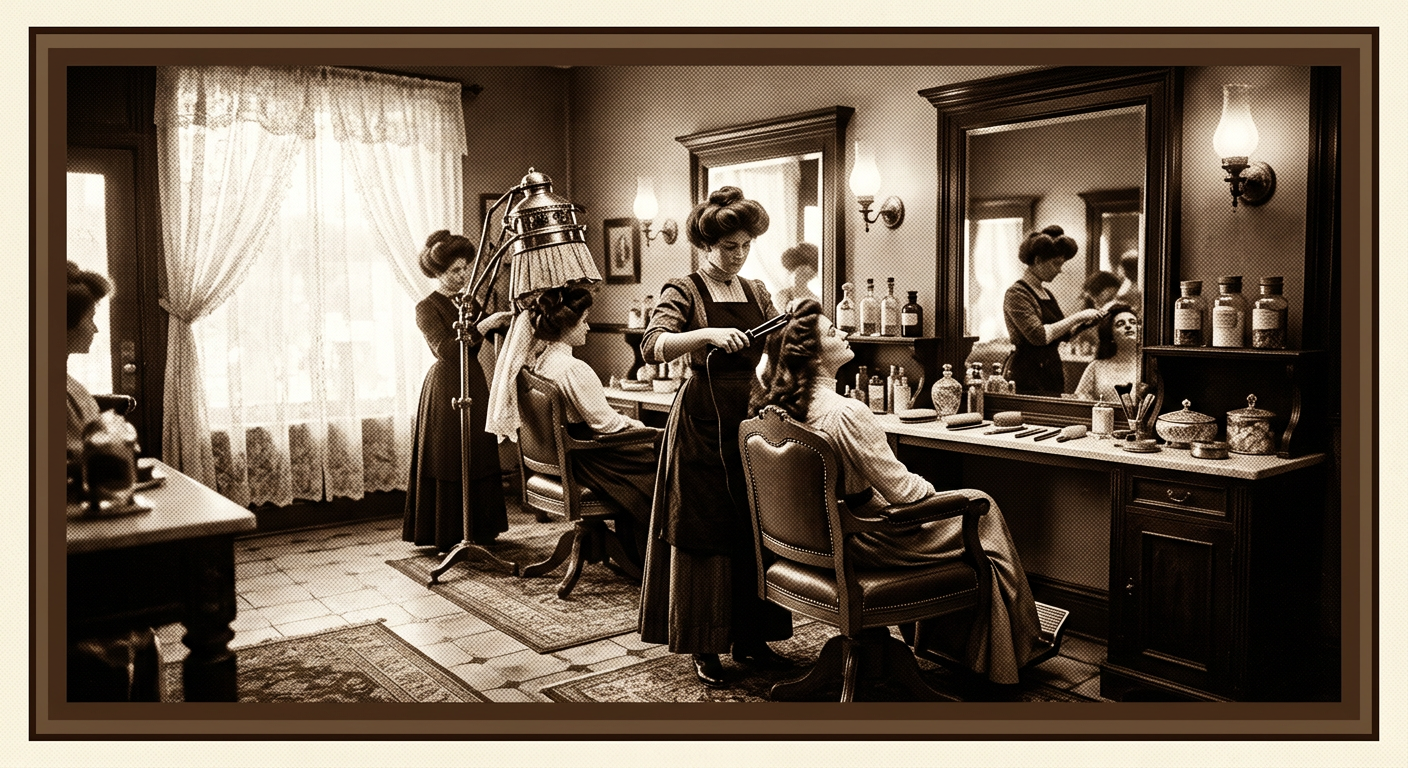
Once a full page could sell a feeling, everything with a lid on it wanted a full page. Pompeian built a mass business out of massage cream and beauty powder on precisely that model, complete with an invented house authority, Madame Jeanette, of whom no trace as a real person survives. Richard Hudnut, who had begun by turning his father's New York drugstore into a showroom elegant enough to be a tourist stop, launched Three Flowers in 1915 and built around it his first integrated skin-care and make-up line, powder, rouge, lipstick, talcum, toilet water, all under one fragrance. Djer-Kiss came in from Kerkoff of Paris through an American importer and sold talc and toilet water on the promise of magnetisme.

And the place to buy them moved. Hudnut's goods sold through department stores as well as pharmacies, which put scent and powder alongside gloves and hats rather than behind a druggist's counter next to the liniment. A Djer-Kiss advertisement of the 1920s ends with a five-word instruction that would have been meaningless in 1900: At your favorite beauty counter.

The page sold the feeling. The counter sold the object. Between 1911 and the end of the decade, American women acquired a place to go and collect what the magazine had promised them.
Afterward
Helen Lansdowne married Stanley Resor in 1917, the year after he and his partners bought J. Walter Thompson. He ran the administration and the clients; she ran the copy. Colleagues could not always tell where one decision ended and the other began, since much of the business was settled over dinner or on the train home to Greenwich.
She built a Women's Editorial Department and staffed it with educated, ambitious young women, several of them active in feminist causes, and she went on writing: Pond's, Maxwell House, Crisco, Aunt Jemima. She marched in parades for woman suffrage. The New York Herald Tribune called her the greatest copywriter of her generation. One of her proteges, Nancy Stephenson, described a brilliant mind that darted and dipped and swooped.
“Supplied the feminine point of view.”
Helen Lansdowne Resor, on the work of her department
The irony has been noted, most sharply by Jennifer Scanlon: a woman who insisted on her own independence, and manufactured it for other women, did so by writing pages that offered the reader a narrower life than the one their author was living. Both things are true and neither cancels the other. She was posthumously elected to the Advertising Hall of Fame in 1967, and Advertising Age placed her fourteenth on its list of the hundred advertising people of the twentieth century.
She died on January 2, 1964.
Look at the hand again. Nothing in the picture has happened yet.
- Ladies' Home Journal reached one million subscribers in 1903, the first American magazine to do so.
- The Andrew Jergens Company bought eight Woodbury products from John H. Woodbury in 1901.
- The Woodbury Book sold out a first edition of 10,000 copies at 50 cents in 1911.
- Woodbury's Facial Soap held at 25 cents against ten-cent competitors in 1915.
- Woodbury sales reached 2,147,000 dollars by 1919.
- Jergens cut Woodbury's Facial Soap to 10 cents in 1934 and 5 cents by 1939.
- The slogan stayed in service from 1911 into the 1940s.
- Advertising Age ranked the campaign 31st among the hundred best campaigns of the twentieth century.
- Advertising Age placed Helen Lansdowne Resor 14th among the hundred advertising people of the twentieth century.
- Helen Lansdowne Resor was elected to the Advertising Hall of Fame, posthumously, in 1967.


The hero and the two scene illustrations are original recreations in the period manner, evoking the 1911 Woodbury advertising and its world; the famous 1911 illustration was by Henry Hutt. The advertisements captioned from the record are real public-domain scans, 1911 to 1919, each a link to its page at the Internet Archive.
That is what she sold, and the industry has been selling the moment before ever since.