
The Color Counter
Red, pink, coral, and a pale eye in three shades of blue. Five years of American color, read off the counter, the screen, and the page.
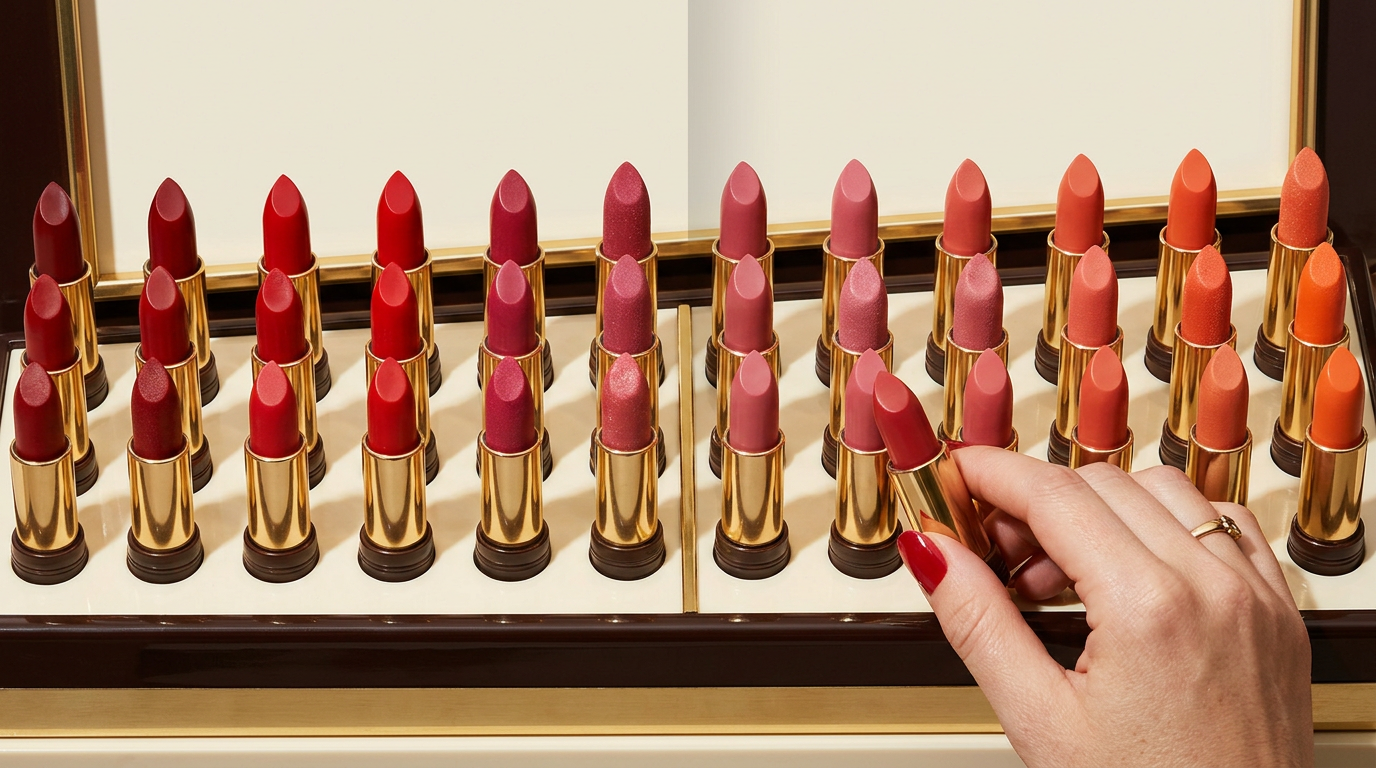
A woman at a counter in the autumn of 1955 is asked to choose between roughly thirty-three shades of Revlon alone, and she will choose one in under a minute, on a name. This is new. Twenty years ago she asked for a lipstick and was handed a lipstick. Now she asks for Cherries a la Mode, or Love That Pink, or Hot Coral, and the girl behind the counter knows exactly which slot to reach for, because the shade arrived in a magazine spread six weeks ago with a window display and a matching nail enamel and a name that a copywriter in New York was paid a great deal of money to find. The half decade has done something peculiar and irreversible to color. It has given it vocabulary.
The color that would not leave
The story starts, as most of the decade's stories do, with chemistry rather than taste. In the summer of 1950, at Lord and Taylor, a chemist named Hazel Bishop put a lipstick on sale for a dollar a tube, and it sold out on the first day. Her formula used bromo acid dyes, which stain the lip rather than sit on it, and the tag her advertising gave it was the one everyone still repeats about it staying on her and not on him. Bishop had worked on aircraft fuel during the war. She reached the formula, by her own account, after 309 experiments in a home kitchen.
What followed was less a fashion than an arms race. Bishop's advertising, run by Raymond Spector, went heavily into television when almost no cosmetics house would, and by 1953 the firm held a quarter of the American lipstick market while spending better than a third of its gross income to hold it. Revlon answered in 1951 with Indelible-Creme, a lanolin formula in twelve fashion shades, and sold books of blotting papers alongside it, because the new indelibles required a woman to set the color and blot it before it would behave. In 1953 the Federal Trade Commission ruled that no lipstick could be called indelible or non-smear without the qualifying word type, which cost Bishop her best line and cost Revlon its product name. Lanolite replaced Indelible-Creme in 1954 and disappointed. Then Coty came in with "24" this year, on a promise a woman could hear in her sleep.
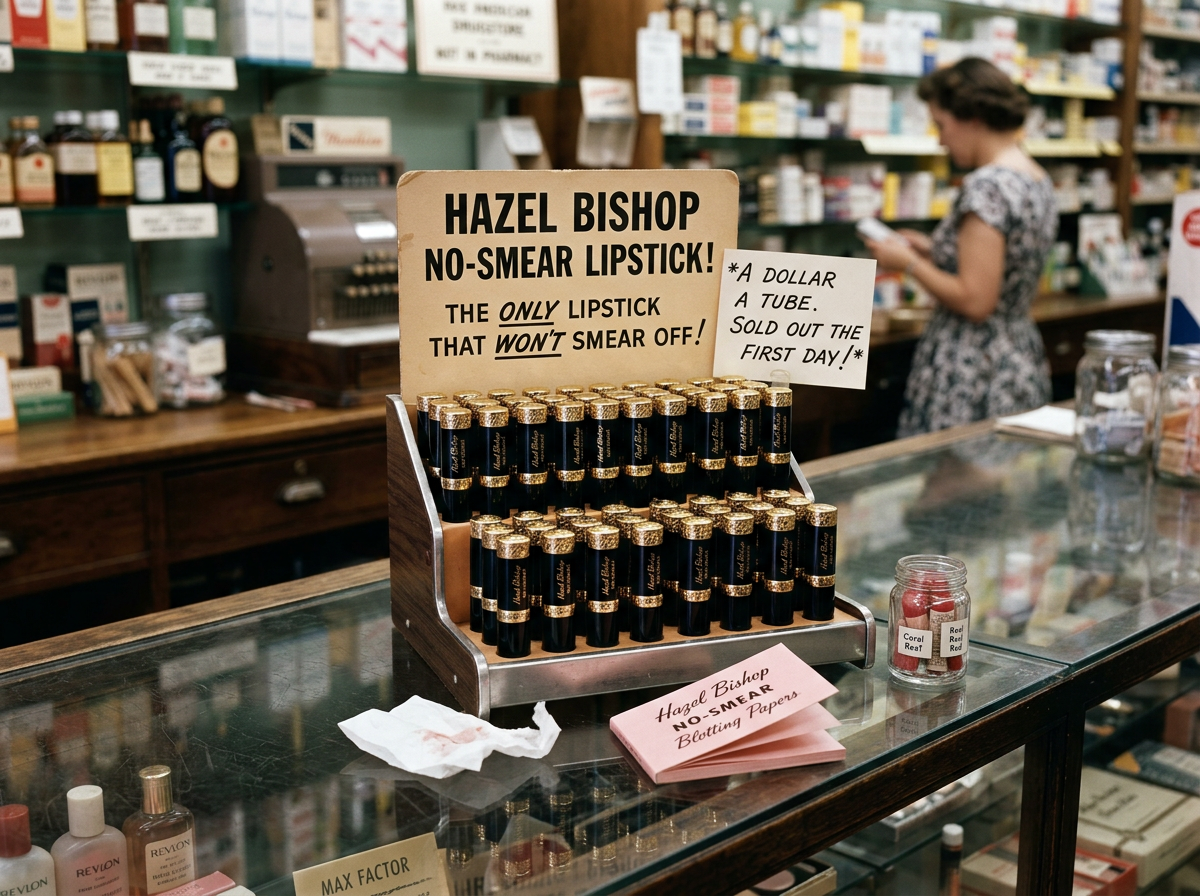
“Wake up beautiful with 'alive' color glowing on your lips!”
Coty "24" advertising line, 1955
Revlon's reply, Living Lipstick, arrived within months on a nearly identical promise, and the two houses went to law over it. The important thing for the counter is what the fight produced: a lipstick that survives a cigarette, a coffee, a dinner and a doorstep. Once color stopped coming off, color could be sold as a possession rather than a consumable, and a woman could reasonably own six.
Red, and the autumn it was named
Red is the decade's given. What changed is that red acquired authorship.
In the autumn of 1952, Revlon ran a two-page spread. On the left, the model Dorian Leigh in a silver sequinned dress under a scarlet cape, photographed by Richard Avedon. The cape was copied from a Balenciaga; the dress had no back and was held together with safety pins. On the right, no product shot at all, but a questionnaire, fifteen questions under a headline that asked the reader whether she was made for it. Eight yeses and she qualified. The shade was Fire and Ice, the copy was by Kay Daly of Norman, Craig and Kummel, working with Revlon's Beatrice Castle, and Vogue built its November issue around it.
The trade noticed what the reader felt. Business Week, surveying the campaign, credited it with combining dignity, class and what the industry politely calls glamour, and the phrasing of the questions did something no beauty page had quite done: it addressed the woman buying the lipstick rather than the man she was presumed to be buying it for. Revlon's sales for the year came to nearly twenty-five and a half million dollars.
“Are you made for Fire and Ice?”
Revlon, two-page spread, autumn 1952. Copy by Kay Daly
Around that one shade the decade's other reds arrange themselves. Max Factor had already sorted red by complexion rather than mood, offering a Clear Red, a Blue Red and a Rose Red for each of its four color types, a system inherited from the studio floor. Revlon named reds the way a novelist names characters: Certainly Red in 1947, Where's the Fire? in 1950, Love That Red in 1951, Say It With Roses in 1952. And in 1953, in Paris, Christian Dior put out eight lipsticks under Parfums Christian Dior, the house Serge Heftler-Louiche had run since 1947. It was the only color cosmetic to appear in the couturier's lifetime so far, and it finished the argument the New Look had opened in 1947. A woman could now be dressed to the mouth by a single hand.
Pink, from an inaugural ball to a shelf of enamel
On the twentieth of January 1953, Mamie Eisenhower went to the inaugural balls in pink peau de soie by Nettie Rosenstein, embroidered with more than two thousand rhinestones, and held the descriptions back until the week before so the newspapers ran the photographs cold. The color left the ballroom and did not stop. It went into the private quarters of the White House until the staff were calling the place the Pink Palace, into the bathrooms and refrigerators of the suburbs, and into the language as First Lady Pink.
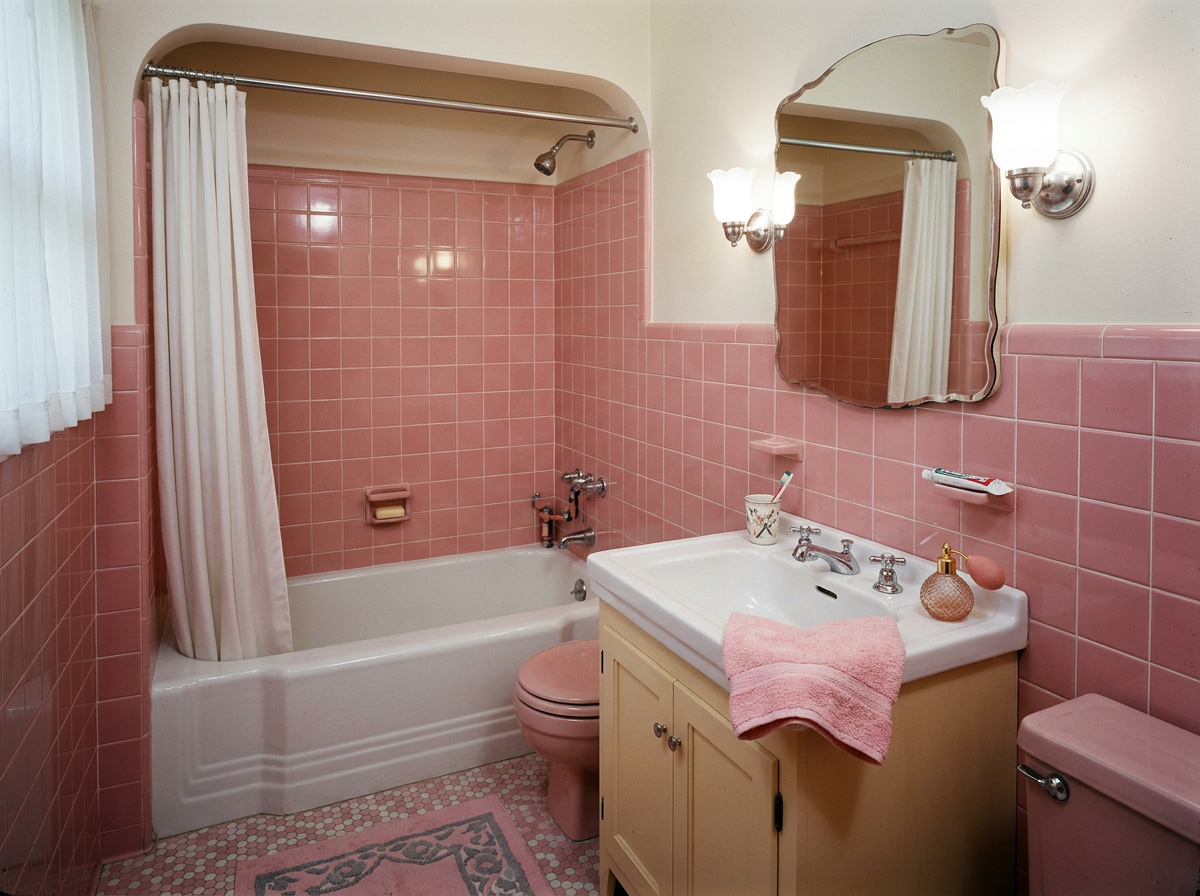
What the record will support is the sequence, and it is worth setting out plainly rather than dressing it as cause. Revlon had Paint the Town Pink in 1951 and again in 1952, before the ball. Crazy Pink and Cherries in the Snow followed in 1953, Kissing Pink in 1954, Love That Pink and Cherries a la Mode this year. Helena Rubinstein put out Torero Pink in 1955. Cherries in the Snow is the one that will be remembered, a raspberry so far from a wartime red that one account of Revlon's own promotion for it reached for the words strange and reckless. In the same period Marilyn Monroe descended a staircase in shocking pink for Gentlemen Prefer Blondes in 1953, in Travilla's gown, in Technicolor.
Four pinks, a First Lady, a musical number and a decade of pink tile. The houses were already selling pink before the gown, and the gown did not need the houses. They simply happened at once, loudly, in color, in a country that had spent the previous decade being told to make do.
Coral, tangerine, and the holiday register
If red is the evening and pink is the house, coral is the third thing the fifties invented: color for daylight and for being seen out of doors.
The names arrive in a run. Max Factor had Coral Glow as early as 1948. Revlon put out Baby Tangerine and Orange Sherbert in 1951, Cinnamon Stick in 1954, and Hot Coral this year, and the confectionery in the naming is not accidental, since the shade is being sold as something light, warm and consumable rather than as an occasion. The color-harmony charts of the period send coral to the brownette and the redhead, and orange-red to the blonde, on the same logic Max Factor used to keep an actress from going gray under a lamp.
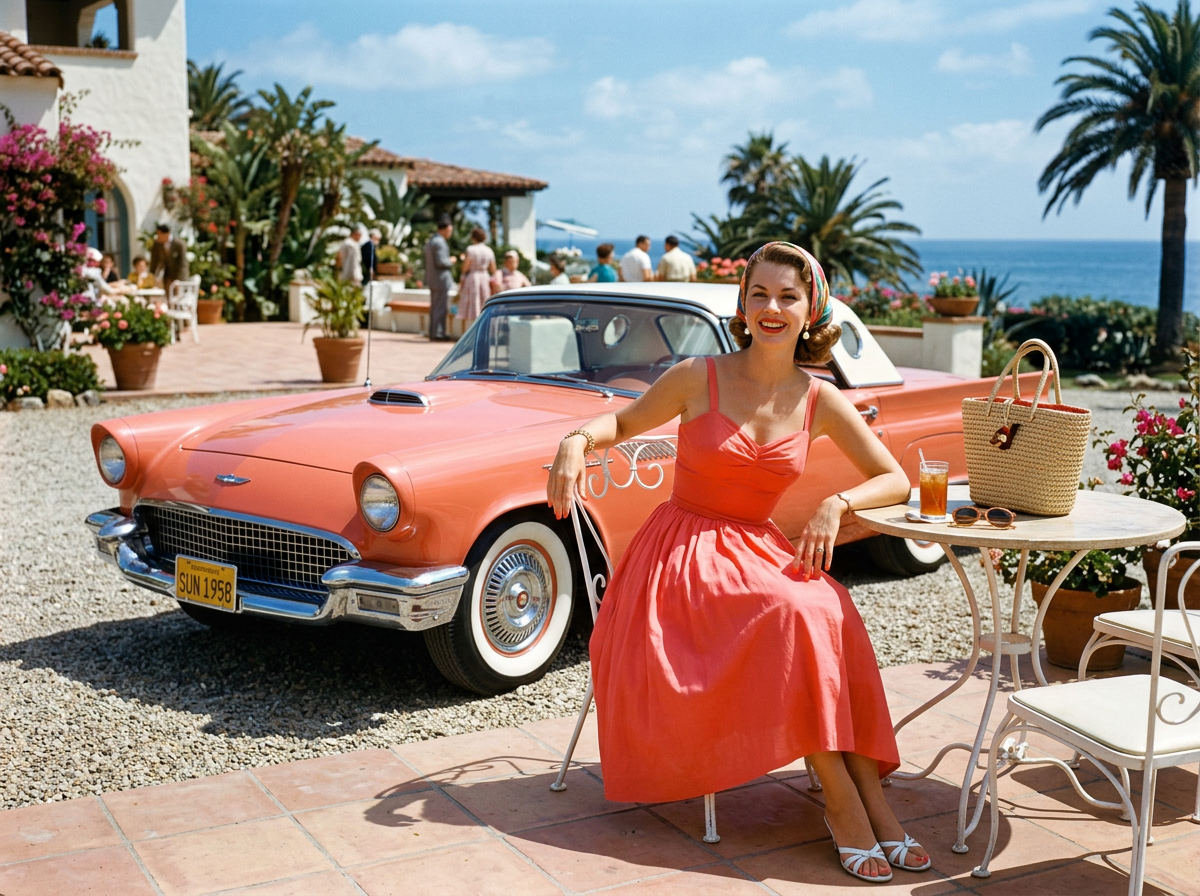
Coral belongs to the resort, the convertible, the terrace and the color photograph, and it is the shade that most obviously answers a country that has begun to take its holidays in Kodachrome. It is also the only one of the three that reads as friendly. A woman in coral is not making an entrance.
The pale face
None of this color would carry without the ground it is laid on, and the ground has been rebuilt from the studio outward.
Max Factor released Pan-Stik to the public in 1948, a cream base in stick form developed in the Hollywood laboratories and tested, among other ways, on models' legs left out in the sun. Creme Puff followed in 1953, base and powder in one, applied with a puff. Erace arrived in 1954, a flesh-colored stick built to take a shadow off a face under lights and sold, for the first time, at the counter to a woman with no lights at all. Revlon covered the same ground from the fashion side with Touch-and-Glow in 1950 and Love-Pat in 1953.
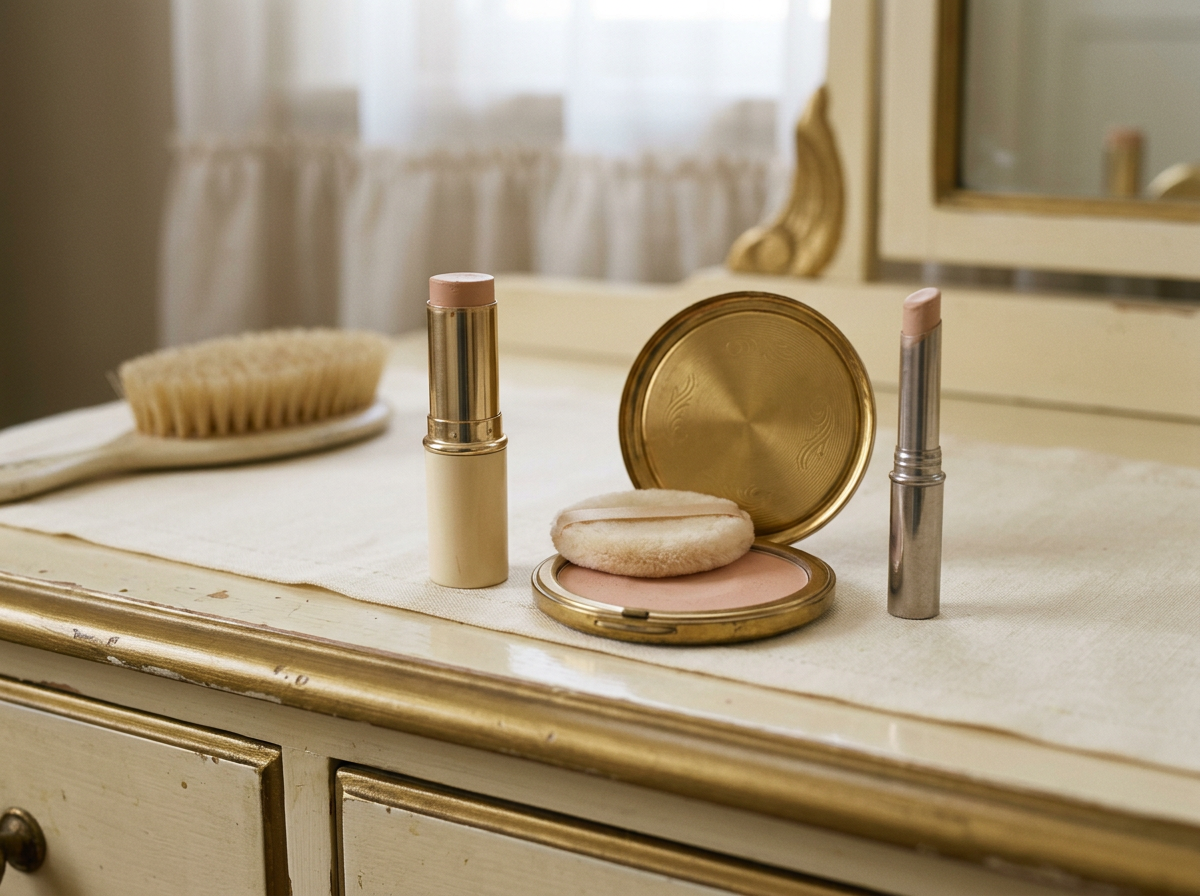
The result is a face that reads as an even, matte, faintly pale field, brows arched and penciled, cheek color used sparingly. Which is to say the fifties face is a surface designed for one loud thing to be placed on it. Rouge retreats so that the mouth can advance.
“Each new color is promoted to the hilt.”
The American Perfumer and Essential Oil Review on Revlon, 1951
The eye learns color
The mouth has had the decade so far. The eye is where the next one is being written, and the evidence is already on the counter.
Revlon's Dreamy Eye Make-up, added in 1950, is worth reading as a document. The cake mascara came in Ice Blue, Royal Blue, Teal Blue, Evergreen, Pistachio, Fresh Violet, Marcasite, Titian, Birchwood, Walnut and Ebony. The stick shadow, in a gold lipstick-type case, came in Blue Frost, Green Frost, Gold Frost, Mauve Frost, Sea Frost and Silver Frost alongside the flat blues and greens. Elizabeth Arden's eye make-up this year adds Opal Blue, Emerald and Violet Argent. These are not colors for a woman being discreet.
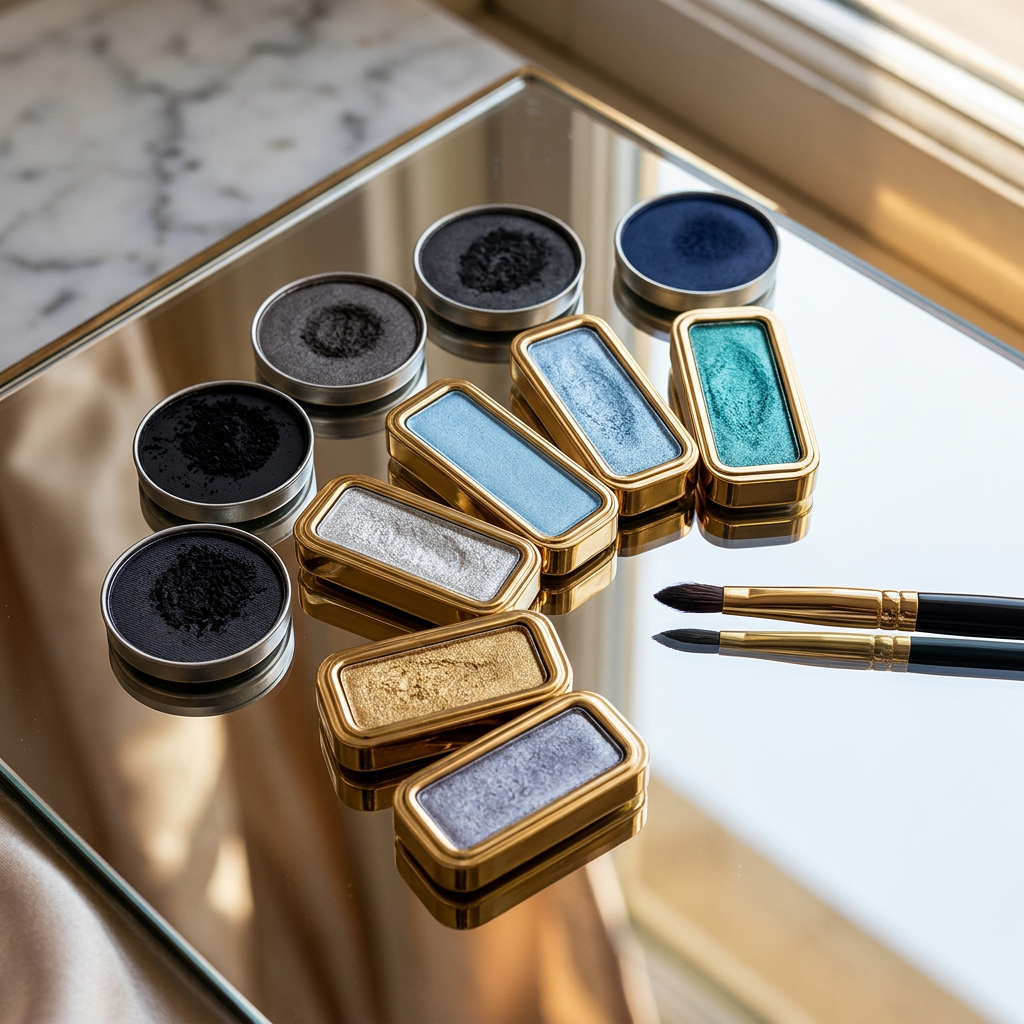
For now they sit under a stronger discipline: the upper lash only, heavily coated; the line drawn out past the corner and lifted; the lower lash bare. Audrey Hepburn has made that shape ordinary. The color is there, in the tray, in eleven shades of mascara, waiting for permission.
The machinery of a shade
Underneath the poetry there is a system, and the system is the real invention of the half decade.
It begins with color harmony, which the houses have been building since the twenties and have now made portable. Elizabeth Arden's Color Wheel works from the premise that any woman can wear any color: turn the wheel to the shade of her dress and read off the powder, rouge, lipstick, eyeshadow and mascara. Max Factor sorts the same problem by four color types. Helena Rubinstein used a Color-Spectrograph. All three are answering the same question, which is what a woman does when the lipstick and the frock are bought in different shops.
Then there is the calendar. New shades appear each spring and each autumn, in pairs of lipstick and nail enamel, so that the mouth and the fingertips match and both can be replaced twice a year. Revlon has done this since before the war and now does it at a scale nobody can follow: magazine advertising that ran to a single New Yorker page in 1935 and to nearly half a million dollars by 1949, full-color spreads, window displays, counter cards, direct mail. This year the house has put its lipsticks into Futurama, a refillable case designed by Van Cleef and Arpels, and added Frosted nail enamels in Platinum, Pink Platinum, Blue-White Platinum and Pink Cloud. A shade is no longer a color. It is a color, a name, a season, a case, and a photograph.
The counter and the salon
There is a second machine running alongside the first, and it concerns who is allowed to buy.
Elizabeth Arden and Helena Rubinstein still keep their addresses on Fifth Avenue, Rubinstein having moved to 655 in 1948, a few doors down from Arden at 691, and the treatment lines they sell are priced as they always were, on ingredients a woman is invited to find exotic. That trade is intact and prospering. What has changed is that it is no longer the only trade. Max Factor sells the studio to the street. Avon sells at the door. Revlon sells through seventeen hundred department stores and better than five thousand drug stores, and Boots relaunched No. 7 in 1952 in black and gold that owes everything to Hollywood.
The effect on color is the interesting part. A shade name costs a woman nothing. Fire and Ice is precisely as expensive to say as it is to want, and the questionnaire that ran beside it in 1952 asked nothing about her income. A house that once sold a woman a place in a salon now sells her a word she can use at any counter in the country, and the word travels further than the salon ever did. Whether the country taught the houses its new appetite for color or the houses taught the country, the record does not say and this page will not pretend to. What can be said is that they have been speaking the same language since about 1950, and that the vocabulary is largely the houses' own.
The screen that cannot show it
There is one flaw in the machine, and it is the largest object in the American living room.
Charles Revson kept Revlon out of television for years on a ground that was, in its way, principled: the medium is broadcast in black and white, and a house that sells nothing but color has nothing to say in monochrome. The trade press reported the position without much argument in 1951, and added the obvious rider, that when color television is perfected Revlon will be in it. Max Factor, whose whole history is the business of surviving a new camera, brought out a make-up range for black-and-white and color television in 1954, and explained the problem in the flat language of the laboratory: light complexions come through a spotty, ghostly white.
Then, on the seventh of June this year, The 64,000 Dollar Question went on the air on CBS with Revlon as its only sponsor. Revson thought little of the program. Within four weeks it was the highest-rated show in America, and almost anything named on it emptied off the shelves. Revlon's sales stood at 33.6 million dollars for 1954. The house went public on the seventh of December, six months to the day after the premiere, at twelve dollars a share.
So the decade arrives at its own joke. The most sophisticated color system American business has ever built has just found its largest audience on a screen that cannot show a single one of its shades, and it is selling them anyway, on a name and a voice.
And so
Which returns us to the rack. Thirty-three bullets, six seasons, four houses, and a woman with two fingers on one tube. She is not choosing a color. She is choosing which of the last five years she intends to be wearing this evening.
Revlon shades introduced, 1950 to 1955. Swatch colors are interpretive, keyed to the shade names, not measured from the originals.
- Hazel Bishop lipstick sales: about 50,000 dollars in 1950, above 10 million by 1953.
- Hazel Bishop share of the American lipstick market by 1953: 25 percent, on better than a third of gross income spent on advertising.
- Revlon total sales in 1952, the year of Fire and Ice: nearly 25.5 million dollars.
- Revlon magazine advertising: 396 dollars in 1935, 120,000 in 1941, 492,736 in 1949.
- Revlon total sales in 1954: 33,604,000 dollars. The house went public on 7 December 1955 at 12 dollars a share.
- Revlon lipsticks in the 1955 Lanolite range: 33 shades.
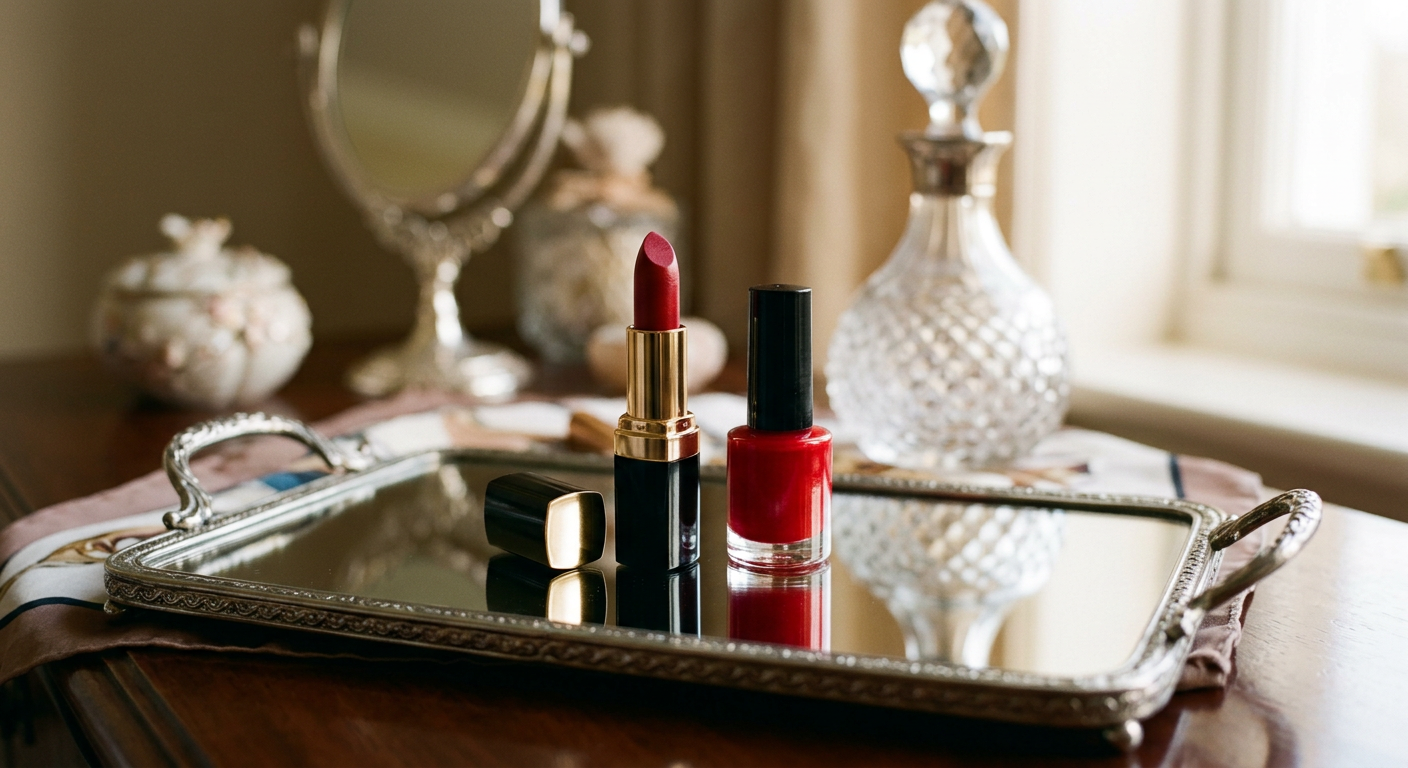
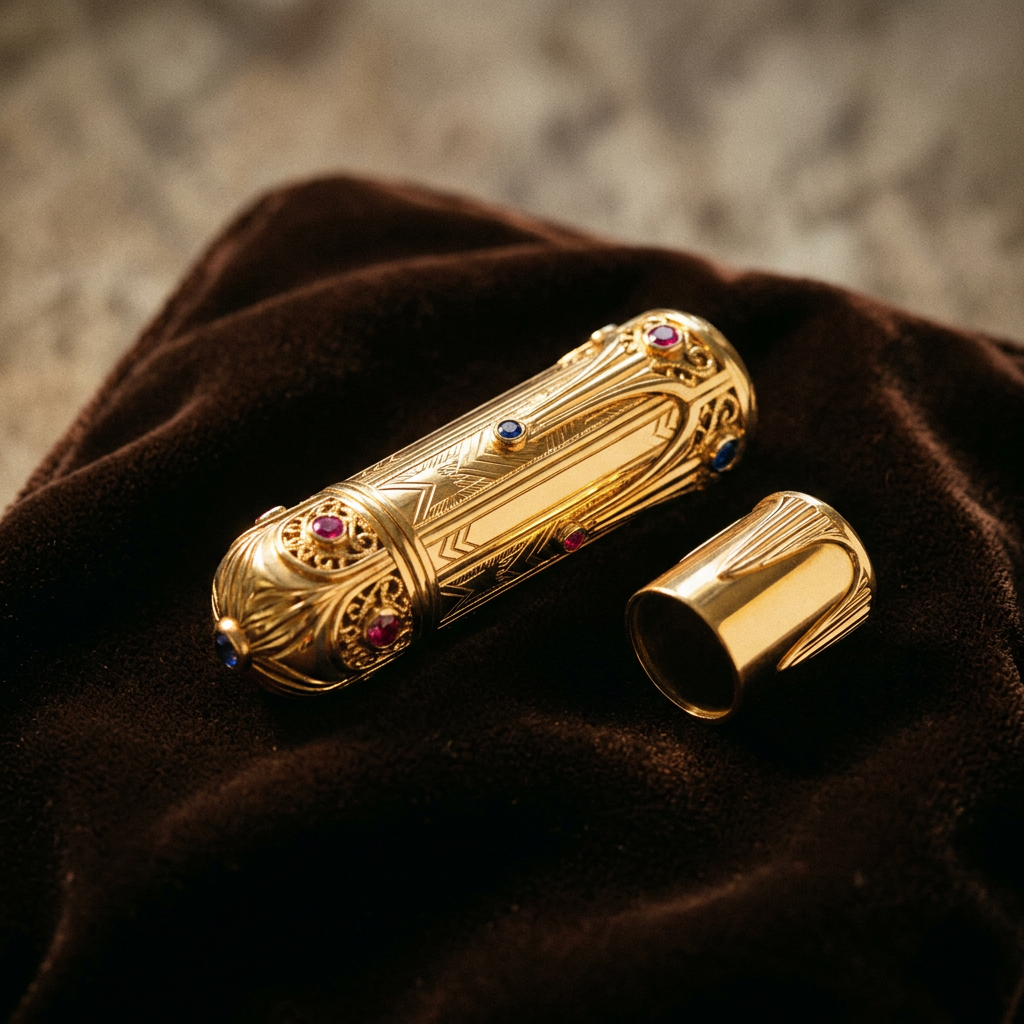


The images above are original recreations in the period manner, not period scans. The advertisements this feature names, Fire and Ice, Coty 24, the Futurama case, and the Eisenhower gown, remain in copyright, and the Muse Parlor rights-clear record runs to 1930. The two plates below, marked From the record, are real public-domain scans; the shade swatches are interpretive.
The counter keeps them all, in rows, turned up an inch, waiting to be named again next spring.